A chat that remembers
Close the terminal, come back tomorrow: geistr continues where you left off, and you can switch to a bigger model mid-conversation. Each conversation is a plain file on your computer.
geistr chat
Open source · Linux and macOS · CPU or GPU
geistr picks an open model that fits your memory, downloads and verifies it, and runs it on your laptop or a Raspberry Pi. No Python, no cloud, no account: your conversations stay on your computer.
# macOS (Apple Silicon) $brew install geisten/tap/geistr# Linux (x86_64, arm64) $curl -fsSL https://www.geisten.net/download/geistr/install.sh | sh# then $ geistr chat
Windows is not supported yet. For Python: pip install geistr · geistr on GitHub
/model gemma4-e2b in the same conversation. The answers are not fact-checked.What geistr does
Models from the catalog (Qwen3, Qwen3.5, Gemma 4, BitNet, SmolLM2 and more) or any supported GGUF file.
Close the terminal, come back tomorrow: geistr continues where you left off, and you can switch to a bigger model mid-conversation. Each conversation is a plain file on your computer.
geistr chat
Index a folder of notes, Markdown or PDFs. Each answer names the files it drew on. The index stays on your computer.
geistr chat --files ~/Notes
An OpenAI- and Ollama-compatible API on your own machine. Connect Open WebUI, editor plugins or the OpenAI SDK as you would to Ollama.
geistr serve gemma4-e2b --http
The catalog ranks models for your memory and the speed measured on your own hardware. Every download is verified by SHA-256.
geistr catalog
Under the hood · geistlib
geistr runs on geistlib. You can embed it in your own program: a static library with no runtime dependencies, and a C API that Python, Rust, Go or JavaScript call through their FFI.
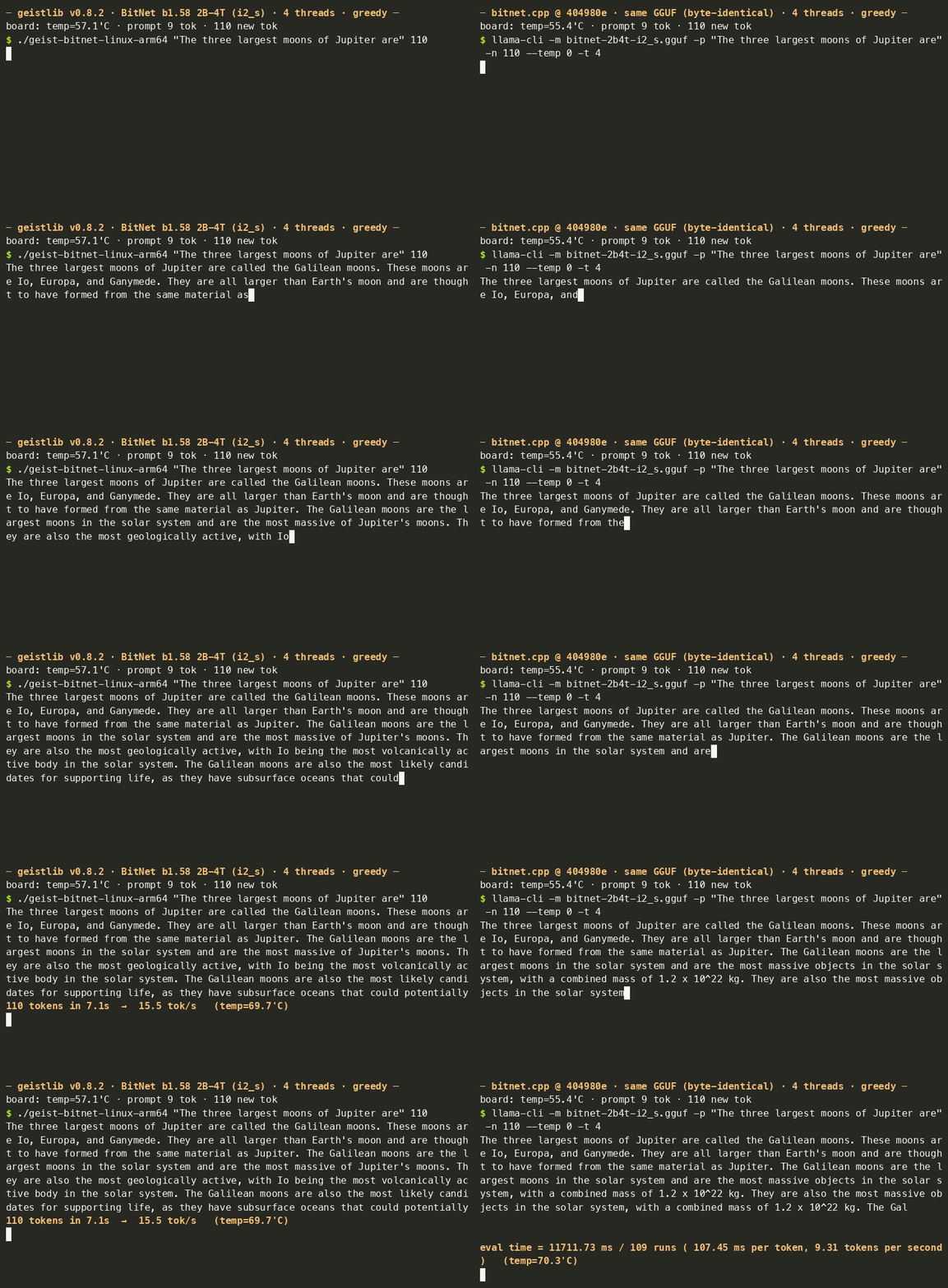
i2_s). Recorded one after the other from a thermally gated board and shown side by side: geistlib v0.8.2 at 15.5 tok/s, bitnet.cpp 404980e at 9.3 tok/s. 4 threads, greedy, 110 new tokens. How it was recordedBenchmarks
geistlib against llama.cpp b11429 on the CPU, nightly: same model file, same threads. On the Ryzen 9 9950X geistlib is ahead in reading and writing for all eight models; on the Raspberry Pi 5 it writes faster in all five, but reads the prompt slower in four. Decode is writing the answer, prefill is reading the prompt. Speed only, not a quality comparison. Code, raw data and method are public.
| Model | Hardware | Decode | Prefill |
|---|---|---|---|
| Qwen3 0.6B · Q8_0 | Ryzen 9 9950X | +10 % | +22 % |
| Qwen3.5 0.8B · Q8_0 | Ryzen 9 9950X | +16 % | +55 % |
| Gemma 4 E2B · Q4_K_M | Ryzen 9 9950X | +18 % | +24 % |
| Gemma 4 E4B · Q4_K_M | Ryzen 9 9950X | +16 % | +48 % |
| Llama 3.2 3B · Q4_K_M | Ryzen 9 9950X | +7 % | +42 % |
| Qwen3.5 4B · Q4_0 | Ryzen 9 9950X | +12 % | +86 % |
| Qwen3.8 27B · Q4_0 | Ryzen 9 9950X | +8 % | +90 % |
| BitNet b1.58-large · TQ2_0 | Ryzen 9 9950X | +45 % | +25 % |
| Qwen3 0.6B · Q8_0 | Raspberry Pi 5 | +4 % | −16 % |
| Qwen3.5 0.8B · Q8_0 | Raspberry Pi 5 | +15 % | −6 % |
| Gemma 4 E2B · Q4_K_M | Raspberry Pi 5 | +13 % | −4 % |
| Qwen3.5 4B · Q4_0 | Raspberry Pi 5 | +28 % | −33 % |
| BitNet b1.58-large · TQ2_0 | Raspberry Pi 5 | +27 % | +30 % |
Live benchmark matrix: nightly runs per model and machine, with history and every run's report.
Works well
Not solved yet
Next for geistr: tools over MCP and reusable skills, then a toolkit for building your own local AI, including typed decisions instead of generated text. Plans, not features.
Speed of geistlib relative to llama.cpp release b11429 (v0.6.0, 5 October 2026, commit d81235049), the newest release at the time of the runs: decode is text generation (tg64 at a 512-token context), prefill is reading the prompt (pp512). Newest nightly run per cell, 18 to 21 October 2026, geistlib c993379b0 or 24515004c, BLAS-free release build. Several cells have only one or two runs so far under this build. Same model file for both engines, same threads, median of 4 alternating cycles × 3 samples. Ternary Bonsai 2 27B is measured against a different llama.cpp build and left out here. On the GPU (Vulkan, RTX 2080 Ti) decode is behind llama.cpp in 6 of the 7 models measured against the same commit.
| Hardware | geistlib | bitnet.cpp | Ratio |
|---|---|---|---|
| Raspberry Pi 5, 32-token prompt | 17.9 tok/s | 9.1 tok/s | 1.96× |
| AMD Ryzen 9 9950X, 128 tokens | 103.1 tok/s | 54.3 tok/s | 1.90× |
Same weights and a cool board for both engines. At a 512-token prompt geistlib decodes 15.0 tok/s on the Pi 5; the baseline's benchmark has no like-for-like number there. Measured 1 August 2026 (Pi 5, 4 GB, geistlib 9b24b1f) and 13 July 2026 (9950X, 16 threads), against bitnet.cpp master. The bitnet.cpp commit was not recorded; a re-run against a pinned version is planned.
Size: geistr 0.3.3 is one 1.8 MB binary with CPU and Metal backends, model catalog and downloader. llama.cpp's llama-cli with the libraries it loads is about 23 MB (Homebrew build of release b11429, Apple M1); llama-cli also contains server and multimodal code. Power: 5.9 W average on the Pi's internal sensors while generating (a proxy, not total draw).
Full article, raw data and limits ·Benchmark table, method and caveats on GitHub
Research
Benchmarks, guides and engineering notes, with methods and limitations.
curl, chmod, run — Microsoft's BitNet 2B compiled into a single 1.2 GB binary, offline, at 15–18 tok/s.
Research Series / geistlibBy building a custom inference engine, I could study how a 2B BitNet model uses the Pi's CPU. It reaches about 18 tokens/s, but speed alone does not show whether a small local model is efficient or useful.
Benchmark / Runtime17.4 tok/s, CPU-only: a reproducible BitNet benchmark on a Raspberry Pi 5.
We are looking for people who run AI on small hardware or work on inference engines, quantisation and small models. Questions, ideas and numbers from your devices are welcome. If your company wants to run small models on its own devices, we help with that too.
geistlib and geistr are written by Dr. Germar Schlegel, physical chemist and C engineer, in Kaarst near Düsseldorf. More about geisten
Ways to join in
geistr bench on your device and share the numbers.